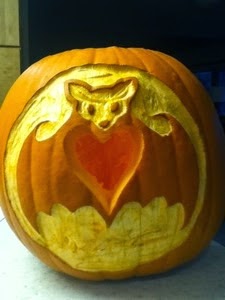
Showing posts with label Bats. Show all posts

Wednesday, October 22, 2014

National Bat Week: October 26-November 1


Join us in celebrating the first ever National Bat Week! We're asking everyone to spread the word this Halloween season that bats are important, not scary.

Whether you're looking for an event to attend or activities to do at home, you can find lots to choose from on our Bat week page or onFacebook. Find your perfect way to celebrate today!


NEW! Save the Bats Campaign
A healthy environment takes healthy bats. And with North American bats dying in record numbers, we know it's going to take all of us working together to protect the bats and to keep our environment healthy.

Our new Save the Bats campaign does just that--it gives people easy ways to help and connects people to others who care. Bat house building, gardening, teaching others--there is something for everyone.

Ready to find out more? Visit www.savebats.org and become a friend of the Save Bats Facebook page. Once you're there, you'll be able to learn a lot more about bats and find out all sorts of ways to get involved. 


Your Dollars At Work
Thanks to people like you, we are able to inspire thousands of children and adults to protect biodiversity. When you invest in us, you make the environment healthier and the world safer for bats. 

Your donations are critical to helping us teach people that bats are important and mobilize Americans to become involved in conservation throughout the year. Please consider making your tax-deductible gift today by using our secure online form

The path to protecting bats begins with you. Thank you for your support! 

The Organization for Bat Conservation is an environmental education nonprofit and wildlife sanctuary specializing in bats and other nocturnal animals. At our home base at the Bat Zone in Bloomfield Hills, MIchigan, we care for more than 150 bats from around the world. Each year, we teach hundreds of thousands of people about bats through Bat Zone tours, traveling live animal programs, exhibits and festivals and inspire people to protect these important animals. 


Tuesday, September 3, 2013

Little Scratches in the Night - August 24, 2013, Another Tale From Lightfoot Bay

 The back of the cabin at Lightfoot Bay

We have had unexpected houseguests since our arrival at Lightfoot Bay. Mice have been leaving presents of little brown pellets in the kitchen. Not that was a big deal for one of the nice things about rustic living is the simplicity of meals so we don’t use many pots and pans while cooking. I scrubbed the counters, drawers and reminded Bob to not use kitchen utensils without washing them first. As for the mice, they obviously benefitted from the collection of food items left in the cabin and decided to summer over with the rest of us.

So, hearing scratches outside my bedroom window and in the ceiling at night was anticipated. There must have been a party Thursday evening as the scratching and running continued throughout the night and into the early morning. Friday night was relatively quiet until just before dawn when the scratching resumed outside my window. Curious to see how many mice were sharing my room, I put on my glasses and looked outside. I couldn’t see any mice but in the corner of my eye a dark bird flew out towards the woods behind the house. Now, my curiosity was piqued and I put on my jacket and went outside.

The sky was still dusky, making it difficult to make out clearly the peak of the roof where my room was situated. While I was watching a bat flew out from under the eave, leaving behind a chorus of chattering relatives behind at the house. It all happened so quickly, that I didn’t have time to even raise my binoculars to get a better look.

I am fascinated by bats and had always wanted to work with them while I was a rehabilitator. They are unusual creatures, the only mammals that technically fly (flying squirrels glide through the air so they are not officially flyers). Bats hibernate over winter in buildings, caves and mine shafts and are essential to farmers as bats consume large quantities of harmful insects.

Unfortunately, bats are often seen in negative light to the general public. Scared by stories of vampire bats and incidents of bats tangled in hair, people often will harm these animals needlessly. Added to their poor but misguided reputation, North American bats have been dying in the millions from a fungus carried here from Europe, White Nose Syndrome. White Nose Syndrome describes the physical appearance of the disease, as the fungus covers the nose and face with a white mask. The disease currently has no known cure and is spreading westward from its first identification in New York State now spread into 22 states and five Canadian provinces. (a)  The total financial loss to agriculture due to White Nose Syndrome is estimated at $3.7 billion in 2011 (b). Combined the bat die off with the on-going bee colony collapses and the agricultural industry will be forced to utilize more artificial means to maintain crop levels.  Not a good solution for farmers in terms of additional production costs, families who will be eating more food grown with chemicals and nature that will lose a key player in the cycle of life.

(a)    USGS National Wildlife Health Center, White Nose Syndrome News, Conservation of Pennsylvania’s bats is now ‘survivor management’, July 9, 2013
http://www.nwhc.usgs.gov/disease_information/white-nose_syndrome/index.jsp

      (b)   Economic Importance of Bats in Agriculture, Boyles, Cryan, McCracken, Kunz, SCIENCE,
            April 1, 2011